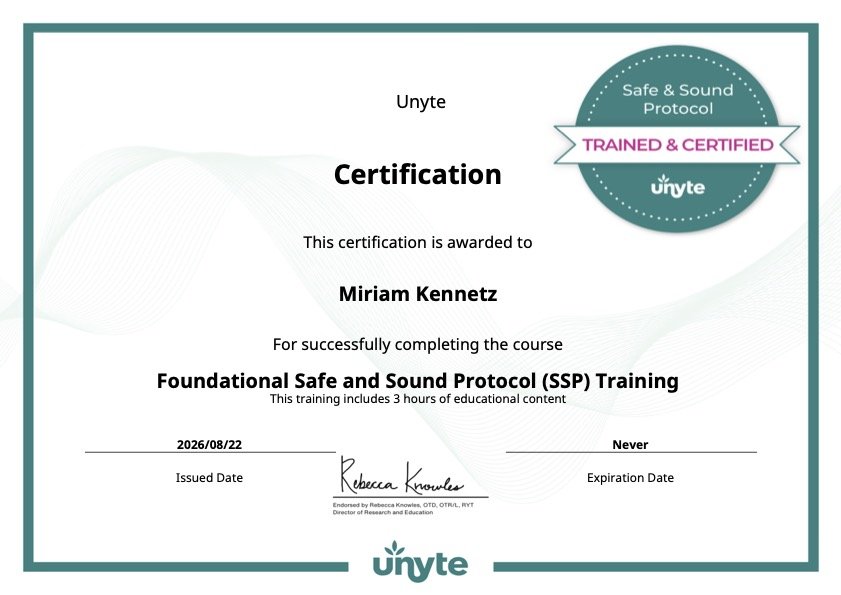
Safe & Sound Protocol

safe and effective for all agesThe Safe and Sound Protocol (SSP) is a powerful and non-invasive listening therapy that is based on Dr. Stephen Porges’ Polyvagal Theory. The program is designed to help regulate the nervous system, so you can better connect with yourself, others, and the world around you.
Through the specially filtered music, the SSP sends cues of safety to your nervous system, building the foundation for awareness, embodiment and resilience. Clients progress through 5 hours of a listening program. The filtered music highlights frequencies that are similar to the human voice. The frequencies of the music directly stimulate the vagus nerve and support feelings of safety, connection, and balance. Services can be provided as an add on/bundled service to scheduled therapy sessions or as a stand alone service. This service can be provided on site with therapist present or via remote sessions.
The nervous system is always looking for cues of safety from other people through things like body language, facial expression, or tone of voice. Some people have a harder time interpreting these cues of safety. Difficulty with interpretation of safety cues and connection can be due to sensory differences, neurological differences, learning differences, or past traumatic experiences. This can lead the brain and body to misinterpret cues from others or the environment, limiting one’s ability to connect in a meaningful way.
What does the SSP help with?
Auditory Defensiveness
Auditory Processing
Sensory Processing & Modulation
Access to Higher Cognition & Focus
Behavioral State Regulation
Enhancement of Social Engagement
Feelings of Safety & Connection
Nervous System Resilience
Enhanced Flexibility to Adapt to Stressors

SSP is used to support clients experiencing:
Trauma
Sensory Challenges
Social Communication Difficulties
Social Emotional Difficulties
Inflexibility & Rigid Thinking
Anxiety & Overwhelm
GastroIntestinal Difficulties
Chronic Pain
Polyvagal Theory: The Science of Feeling Safe
Developed by world-renowned researcher and Unyte’s Chief Scientific Advisor, Dr. Stephen Porges, Polyvagal Theory focuses on what is happening in the body and the nervous system, and explains how our sense of safety, danger or life-threat can impact our behavior. Understanding Polyvagal Theory gives us a scientific framework that can be applied through physiological, or “bottom-up” therapies, to help change and improve how we feel, think and connect with others.